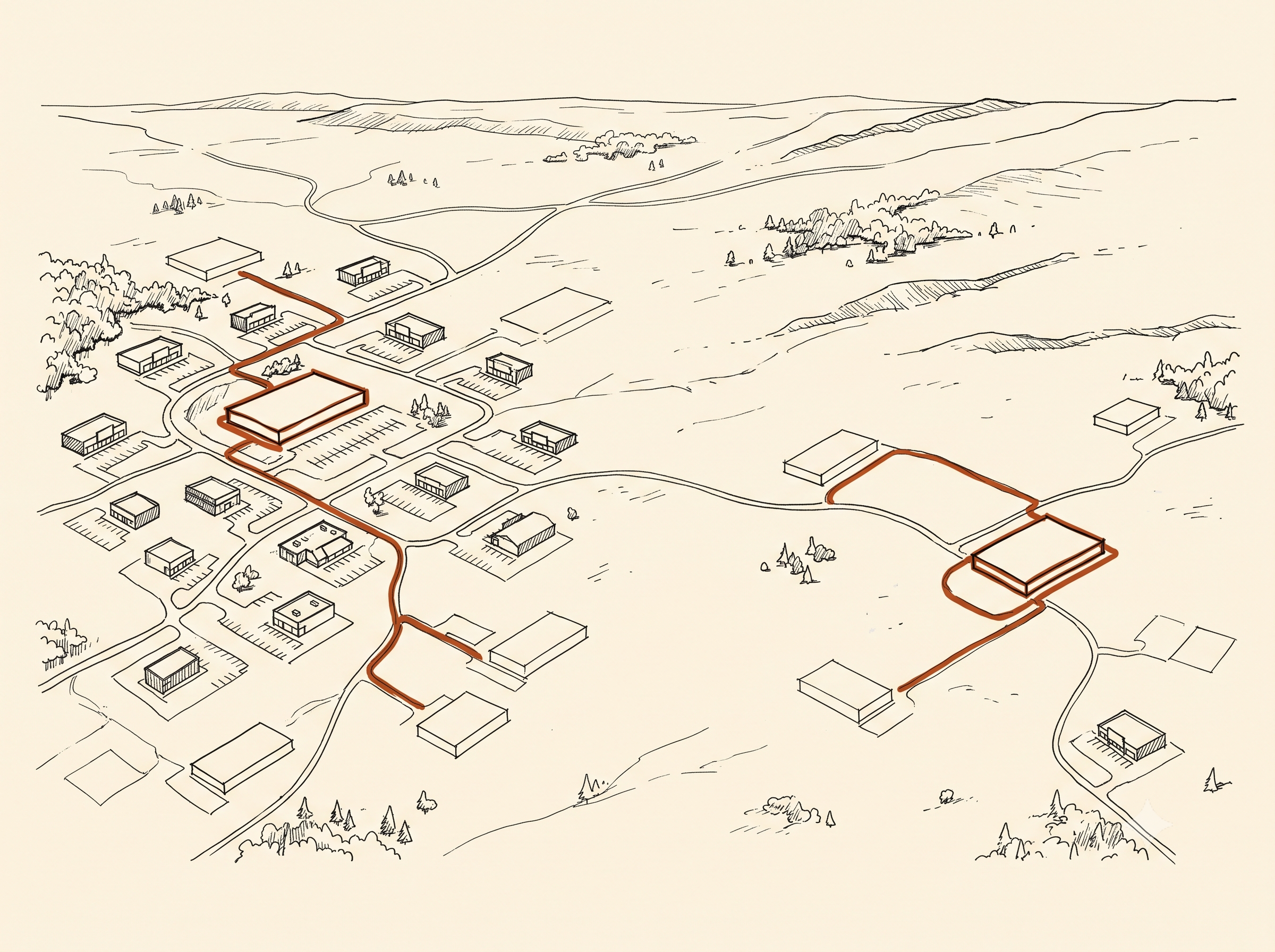
Where the network lives

You're carrying the cost of a network drawn for the old map.

Demand moved. Costs moved. Maybe a tariff line reset overnight, or a merger left you running two sets of plants and DCs that were each designed alone. The sites are where they are because of choices that made sense once. The question is what a better-shaped network would be worth, and whether the move pays for itself.

See your whole distribution network on your own data, test the alternatives side by side, and read cost against service before you sign for the concrete.

Sound familiar?

We keep adding warehouses, and cost-to-serve keeps climbing anyway

A tariff shift blew up our landed cost, and we're fixing it one country at a time

We merged two networks, and "keep both, decide later" became the plan

We hit the cost target and missed the carbon one, and service is stuck in the middle

Nobody can tell me what it costs to serve this customer from where we serve them

We're growing and need another DC, and we're guessing where it should go

  • We keep adding warehouses, and cost-to-serve keeps climbing anyway
  • A tariff shift blew up our landed cost, and we're fixing it one country at a time
  • We merged two networks, and "keep both, decide later" became the plan
  • We hit the cost target and missed the carbon one, and service is stuck in the middle
  • Nobody can tell me what it costs to serve this customer from where we serve them
  • We're growing and need another DC, and we're guessing where it should go

How do we know the network is still the right shape?

The network wasn't built wrong. It was built for conditions that have since moved, one sensible addition at a time, until the whole no longer matches the map. A center-of-gravity study on a spreadsheet can tell you where the middle is. It can't tell you how the full network behaves when you move a site, or how cost trades against service across every lane at once. So the real question isn't where the middle sits. It's what the whole network does when you change its shape, and whether the change earns back the capital it takes.

When something outside forces the question, the trap gets sharper. A tariff shock pulls everyone toward a single alternate country, judged on landed cost alone. A merger's synergy number gets set from the top before anyone models whether the combined network can deliver it. Both are the same mistake: deciding the shape of the network from one number instead of from how the network behaves. And the target you're handed is rarely just cost. It's cost and carbon and service, all pulling against each other, with no shared way to see the tradeoff.

How SimWell solves it

A network optimizer gives you the lowest-cost map. It won't tell you how that map holds when demand shifts or a lane closes.

The work starts the same way every time: a model of your real distribution network, the plants and DCs, the lanes and volumes, the costs and the constraints that bind. We run it across the network shapes you're weighing, on your own data, and it returns a tested profile for each one, not a single optimal dot. You see cost-to-serve by customer and region, service level under each shape, and the same comparison run against carbon, or landed cost under a new tariff regime, or the real synergy a merger delivers rather than the one that was promised. This is where the term footprint earns its place: what you're comparing is whole footprints, not single sites.

Who builds it and who runs it depends on where you're starting from. Either way you keep a decision model your team uses to answer the next network question too, not a slide deck from a study that's already going stale.

Put your priorities in front of the question

Three ways to lift throughput. You decide what matters.

Nothing is pre-crowned. Rank what your organization actually cares about, run the model, and the winner follows your priorities, live. Sometimes the answer is don't build.

Is building a new DC the right move?

  1. 01 Capital discipline Smallest ask that still moves the number.
  2. 02 Throughput Most units out the door.
  3. 03 Service level On-time to the customer, held under real demand.

Add capacity

Build a new DC where the model says it earns its capital.

Re-route flow

Re-solve sourcing and lanes on the current footprint.

Re-sequence the operation

Change what runs when, before touching bricks or lanes.

The scores are schematic. On a real engagement they come out of your model, run on your own network.

How we engage

Where you start depends on what you already know

Four ways in. You pick the one that matches where you are, not a track you have to walk from the beginning.

  1. You're not sure which network decision to attack first

    Decision workshop. A focused session that surfaces and ranks the decisions where modeling pays off first: footprint, sourcing, mode mix, capacity, or resilience. You leave knowing which one to model, why it ranks where it does, and what it takes to answer it.

  2. You know the decision, and you want it answered once

    Scoped project. You bring the specific question: whether to build, where to place a DC, which sites to keep after an acquisition, what breaks if a node goes down. We handle discovery, build, and validation on your data. You keep the model and the answer, inside your environment.

  3. You know the decision, and you want your own team to own it

    Licensing and training. We license the right tools and train your network planners and analysts to build and run the models in-house. The capability becomes yours rather than something you keep buying.

  4. The decision comes back every cycle

    Managed services. Sourcing shifts, tariffs move, customers change what they buy, and a model built once goes stale. We maintain and evolve the models alongside your team, so scenario runs become part of how the network plans, season after season.

What every path leaves behind

Whichever way you come in, the model, the logic, and the capability stay inside your organization, documented and maintainable, so the network keeps answering its own questions long after the work is done.

Resources

More on network shape and cost-to-serve

Eight questions every supply chain leader should ask
Ebook

8 questions your supply chain planning tools can't answer

What a model answers that a planning tool can't. The read for anyone who's been asked, "isn't this just an expensive Excel?"

Get the ebook →

Scaling simulation from project to process
Ebook

Scaling simulation in the supply chain: from project to process

Who runs the model after we leave, and how the capability lives inside your team rather than a one-off engagement.

Get the ebook →
Optimize nearshoring your supply chain
Article

Optimize nearshoring your supply chain

Sourcing's shifting and production's coming closer to home. Where the warehouses should sit now is a footprint question you can answer before you commit.

Read the article →
Common questions before you commit

Common questions before you commit

Can we do this in a spreadsheet, or do we need software and a partner?

A spreadsheet can find the geographic middle of your network. What it can't do is show how the whole network behaves when you move a site, because it averages away the interactions between lanes, costs, and service that decide whether a new shape works. That's the line where a model earns its place: when the decision is expensive enough that being wrong costs more than the study.

Our data isn't clean. Does the project die in data collection?

No project waits for perfect data, because it never arrives. We start with the data you have, make its gaps and assumptions explicit in the model, and tighten them where they move the answer. Most of the time the data that feels messy is good enough to decide the network shape; the model shows you which gaps matter and which don't.

How do we know the model matches our real network?

You validate it against a baseline your team already trusts. Before the model tests any new shape, it has to reproduce how your current network behaves, on your own volumes and costs, closely enough that your planners recognize it. Once it matches what you know, you can believe what it shows you about what you don't.

Get started

Your network is the one the old map justified.

The fastest way to know whether reshaping it pays is to put your own network in front of the question. Book a call and we'll tell you straight.