

Technology
Simulation, optimization, and AI for complex, asset-heavy operations.
Six technologies. Each answers a different question about how your operation behaves, and the question picks the technology, never the other way round.
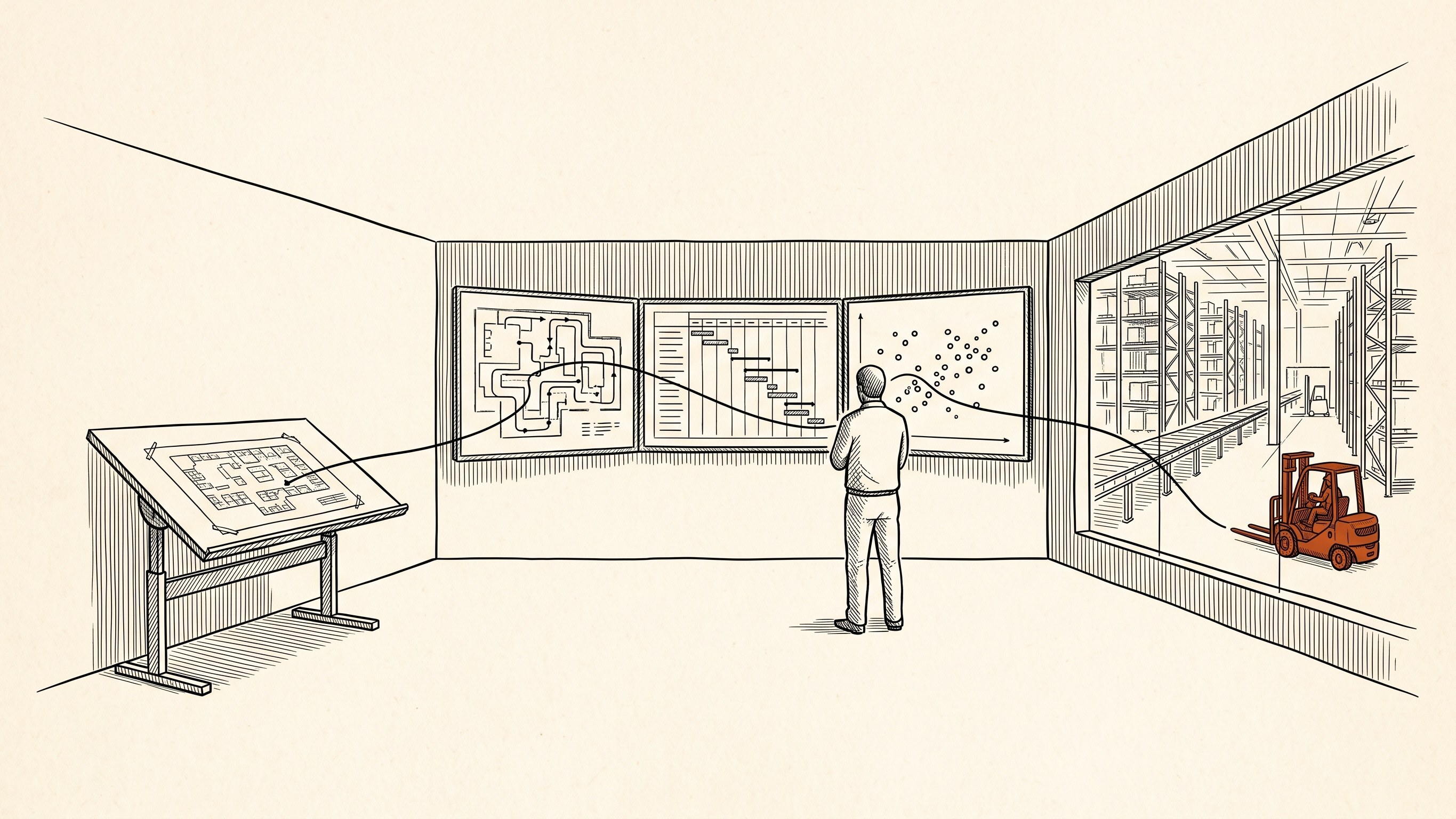
The capabilities
Each one answers a question the others can't.
Open any one to see what it does. For how they come together on a single decision, see Decision Systems.
Simulation
What could happen if we change something?
The operation rebuilt in a dynamic environment that runs through time. Delays cascade, breakdowns collide, bottlenecks move, and options get tested risk-free before anyone commits.
When to reach for it
Reach for it when you have a plan and need to know whether it survives breakdowns, late arrivals, and absent shifts.
Optimization
What's the best plan within our constraints?
Finds the most effective way to deploy resources, schedules, and routes under real constraints, and shows where time, money, and capacity are being lost.
When to reach for it
Reach for it when you don't have the plan yet and need the best one your constraints allow.
AI and machine learning
What can we learn from the model, and from the data?
Learns from what the model and the data have seen: exploring thousands of scenarios, training decision policies inside the simulation, and forecasting the inputs a plan depends on.
When to reach for it
Reach for it when the scenarios outnumber what anyone can run by hand, or the inputs a plan depends on keep moving.
Data engineering
Can we get the right data, reliably?
Pipelines that collect, connect, and deliver data from the systems you already run, so every model is fed by current, validated numbers.
When to reach for it
Reach for it when the numbers exist in three systems and nobody trusts the one on the screen.
Data science
What happened, and why?
Finds the patterns, drivers, and relationships in your history that point to the real opportunities and risks, so a model gets built around what matters.
When to reach for it
Reach for it when the pattern behind the problem is still a guess and you need to know what actually drives it.
Digital twin
What's happening now, and what happens if we act?
A model with live data flowing into it, so every run reflects the operation as it stands at that moment. Used only when that live loop exists.
When to reach for it
Reach for it when the question is about the operation as it stands today, not as it was last quarter.
How we choose
The right tool, not our tool.
The method comes from the question, the software comes from the method, and both connect to the tools your teams already trust. The same problem can get simulation from one team and optimization from another, and the hardest ones get several. The choice gets made after we understand what you're deciding, not before.
What you keep
Validated, documented, and yours.
- ValidatedEvery model is checked against how your operation actually behaves before anyone acts on it.
- DocumentedLogic, assumptions, and outputs are written down and traceable, so a result can be inspected and defended by your own analysts.
- YoursThe model, the data, and the logic stay inside your environment. Start with one question, and the same foundation carries to the next.
Where to start
Start with the decision, not the method.
A capital request you can't yet defend. A plan nobody trusts. A constraint that moved after the money was spent. That's enough to start.
Bring the decision
Tell us what you're deciding. We'll tell you which of these it takes, what it costs to build, and what you'd know at the end that you don't know now.